
Electrolysis for Facial Hair Removal: A Complete Guide
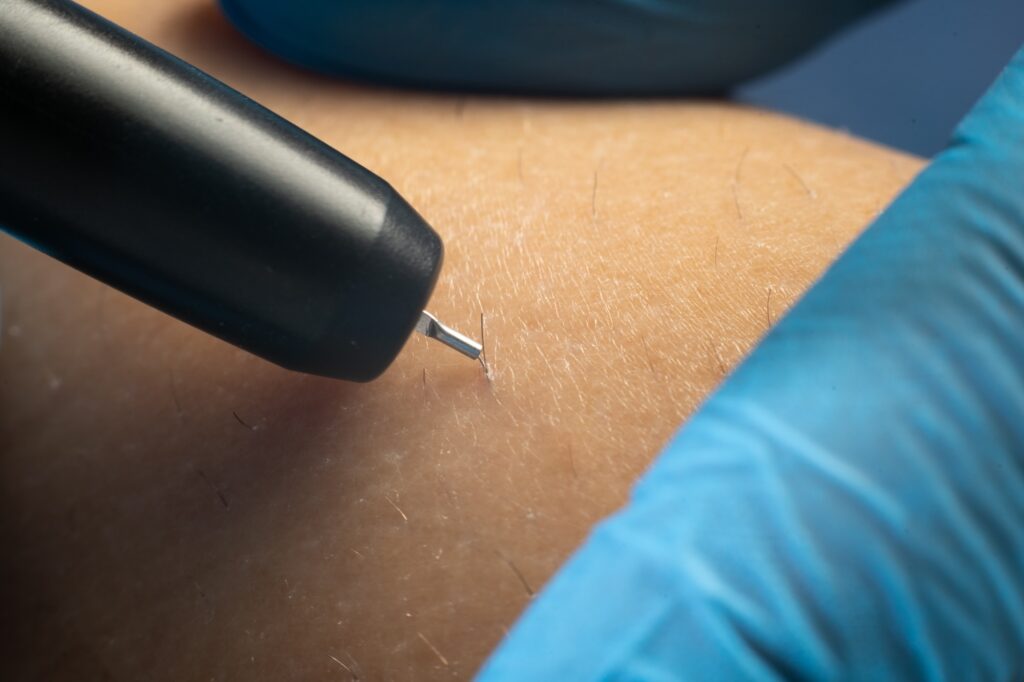
If you’re researching permanent facial hair removal, you’ve noticed that most methods don’t qualify as permanent. Lasers are FDA-cleared for hair reduction, not removal. Waxing, threading, depilatories, and shaving have to be redone indefinitely. Only one method holds the FDA designation of permanent hair removal: electrolysis. The trade-off is time. Electrolysis treats each follicle individually, so sessions take longer than laser. That hair-by-hair pace is also why results are permanent, since every treated follicle receives a current calibrated to destroy it. This guide covers how facial electrolysis works, which areas it’s best for, what each session feels like, and realistic timelines for the upper lip, chin, sideburns, jawline, and other facial zones. Key Takeaways Electrolysis is the only FDA-recognized method of permanent facial hair removal. Laser is FDA-cleared for “permanent reduction” only, not removal. It works on every hair color and every skin tone. White, gray, blonde, red, and dark hair all respond. Skin tone doesn’t affect safety or results because no pigment is targeted. Each follicle is treated individually. Sessions take longer than laser, which is also why the results are permanent. Most facial areas need 8 to 18 months of consistent sessions for full clearance, with hormonally driven hair sometimes needing longer. Common treatment areas include the upper lip, chin, sideburns, jawline, cheeks, neck, between the brows, and brow shaping. Facial skin is more sensitive than body skin, so topical numbing cream is widely used and aftercare matters more. If hormones are driving the hair (PCOS, perimenopause, thyroid, certain medications), pairing electrolysis with medical management produces the best long-term outcomes. Why Facial Hair Is Different The face is one of the most androgen-sensitive areas of the body, which means it’s the first place excess hormonal hair tends to appear. Genetics and ancestry shape the baseline, while life-stage hormonal shifts add to it over time. Roughly 5 to 10 percent of women of reproductive age have hirsutism (excess terminal hair in male-pattern areas like the chin, upper lip, and jawline). That figure rises sharply with conditions like polycystic ovary syndrome (PCOS), where the rate climbs to around 70 to 80 percent. Temporary methods also have specific problems on facial skin. Shaving causes stubble and can irritate sensitive zones. Waxing pulls at thin facial skin and causes ingrown hairs along the jawline. Daily tweezing distorts follicles and creates uneven regrowth. Threading is precise but can cause hyperpigmentation on darker skin tones. Depilatory creams are formulated for body skin and frequently burn or trigger contact dermatitis on the face. Even at-home laser devices struggle on small precision areas and on the lighter or graying hairs that often show up on the face first. Electrolysis addresses these issues. It removes facial hair permanently, works on any color and any skin tone, and offers the precision facial work requires. How Electrolysis Works on Facial Hair The procedure is mechanically straightforward. A fine, sterile probe (often thinner than the hair itself) is inserted into the natural opening of an individual follicle. A precisely controlled electrical current is delivered, destroying the cells that allow that follicle to grow hair. There are three FDA-recognized modalities: Galvanic uses direct current to chemically destroy the follicle by producing sodium hydroxide (lye) at the base. Thermolysis uses high-frequency alternating current to heat and destroy the follicle. Blend combines galvanic and thermolytic action in a single insertion. Many electrologists prefer blend for stubborn, hormonally driven, or coarse facial hair, because it pairs the chemical destruction of galvanic with the speed of thermolysis. At Laser Affair, every electrolysis session is performed using the Apilus xCell Pur, a computerized system that delivers the current with high precision and considerably less discomfort than older equipment. Precision is especially important for facial work, where each insertion has to be exact and the skin is more sensitive than body skin. Because electrolysis targets the follicle directly rather than melanin in the hair shaft, hair color is irrelevant. White, gray, blonde, red, and dark hair all respond identically. Skin tone doesn’t affect outcomes either. For the regulatory and biological background on why electrolysis qualifies as permanent, see our deep dive on whether electrolysis is permanent. The Trade-Off: Permanent Results, Hair by Hair Electrolysis is slower than laser. Laser hair removal sends a beam of light across an area of skin, and the light is absorbed by pigment in many hairs at once, damaging multiple follicles per pulse. That speed is what makes laser efficient for body areas, and it’s also why laser is classified as reduction rather than removal. Because the energy spreads across an area, individual follicles often receive sub-therapeutic doses that damage but don’t destroy them. Hair eventually grows back, sometimes finer, sometimes the same. Electrolysis takes the opposite approach. Each follicle is treated individually with a current calibrated to its specific depth and hair characteristics. The growth cells are fully destroyed. Once a follicle is properly treated, it cannot regrow hair. That’s why electrolysis carries the FDA designation of “permanent hair removal” while laser is limited to “permanent hair reduction.” The arithmetic explains the time difference. A 60-minute electrolysis session can treat several hundred follicles depending on hair density and area. A 60-minute laser session can treat thousands. Laser wins on speed; electrolysis wins on permanence. For facial hair specifically, the hair-by-hair approach offers two advantages that compensate for the slower pace: Precision shaping. Brows, beard line, sideburns, and between-brow areas all benefit from individual hair removal that lasers cannot perform safely. Color independence. Lasers cannot effectively treat the lighter, finer, gray, or white hairs that often appear on the face first. Electrolysis treats all of them. If your goal is the largest possible reduction in the fewest sessions, laser is the right tool for body areas where it’s a fit. If your goal is permanently removing facial hair, electrolysis is the method, and the time investment is the cost. Common Facial Treatment Areas Almost every part of the face is treatable with electrolysis. The notes below cover what people commonly come