
The Definitive Guide to Laser Hair Removal for Dark Skin Tones

For those with brown or darker skin tones, safe and effective laser hair removal treatment depends on understanding how laser technology interacts with melanin, the pigment that colors skin and hair.

We encourage patients to understand how laser hair removal works and to know where their skin falls on the spectrum, so they can enter their appointment knowing exactly what questions to ask and feel confident and secure throughout the process.

Understanding Your Skin Type

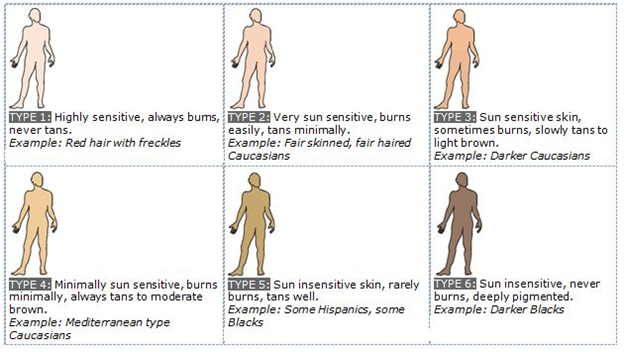
Laser treatment settings are guided by the Fitzpatrick skin type scale, a classification from I (very fair) to VI (deeply pigmented). This scale reflects how skin responds to sun exposure: whether it burns or tans easily.

During consultation, practitioners assess your Fitzpatrick type through examination and questions about sun sensitivity. 

fitzpatrick skin types

Laser Choice is Especially Important for Dark Skin

Melanin in the skin absorbs light and converts it to heat, the same ability that protects brown skin from burning in the sun. Higher melanin concentration means more laser energy is absorbed by the skin’s surface rather than just the hair follicles. This creates a risk: excess heat energy in the skin can lead to pigmentation issues like hyperpigmentation (dark spots) or hypopigmentation (light spots) if not performed by an experienced technician.

Laser hair removal works bycandela lasers targeting melanin in hair follicles, heating and damaging them to inhibit growth. The ideal laser must deliver energy deep enough to the follicle while minimizing absorption by melanin in the epidermis (outer skin layer).
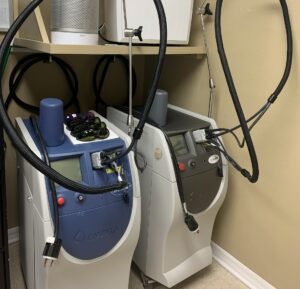
Nd:YAG lasers, emitting at 1064 nm, have a longer wavelength that penetrates deeper and is less absorbed by epidermal melanin. This means more energy reaches the follicle directly, reducing the chance of damaging surrounding skin, making Nd:YAG the best and most effective laser for dark skin tones.

Other lasers, like diode lasers (~800 nm), can be used cautiously at adjusted settings, but shorter wavelengths (such as Alexandrite at 755 nm or IPL devices) are absorbed more by melanin in the skin itself, increasing risks and are generally avoided for dark skin.

Your technician will choose the best laser for you based on your skin tone. Someone with medium brown skin, for example, may be able to use the Alexandrite laser on their underarms, but need the Nd:YAG on their bikini line where the skin is typically naturally dark.

What to Expect During Treatment

Darker skin types typically requires more sessions, often 8 to 12 or more, because practitioners use lower energy levels and increase intervals between treatments to allow the skin to recover and avoid side effects. A test patch is performed initially to observe how your skin reacts before proceeding.

Cooling devices are used during sessions to protect your skin and reduce discomfort. At Laser Affair in Tampa, out lasers use an immediate cooling mist to reduce heat in the skin as soon as possible.

Safety Protocols

Practitioners customize settings based on Fitzpatrick type, hair thickness, and treatment area. They adopt a conservative approach: lower laser output and fewer passes prevent overheating the skin. Longer time between sessions allows pigmented skin to heal properly without getting inflamed.

Experience is crucial. Skilled providers recognize subtle skin responses and adjust treatment on the fly, ensuring safety without sacrificing effectiveness.

Aftercare to Prevent Hyperpigmentation

You should not have to worry about hyperpigmentation if your practitioner has experience treating all skin types. That said, your skin won’t complain if you give it some extra TLC after laser hair removal treatments.

laser hair removal treatment area tampa dark skinThis aftercare applies to people with all skin tones:

  • Consistent daily use of broad-spectrum sunscreen protects treated skin from UV exposure.
  • Gentle cleansing avoids further irritation (no exfoliation).
  • Keeping the skin moisturized supports healing.
  • Avoid touching, picking, or scratching treated areas.
  • Limit sun exposure by wearing hats and protective clothing.
  • Report unusual changes or discomfort to your provider early.

Common Questions

Yes. More sessions are necessary due to cautious energy use.

No. Providers assess it through physical examination and history.

No. At-home lasers, typically IPLs, (intense pulsed light) are not precise, and much of the light energy is absorbed by the skin. 

Diode lasers handle fine hair better, while Nd:YAG is generally better for coarse, thicker hair.

Unlike lasers that focus mainly on melanin, the Nd:YAG laser targets the tiny blood vessels that feed hair follicles. Because this laser passes through the skin’s pigment with less absorption, it produces less heat in the skin itself, making treatments safer and just as effective for darker skin tones.

Scroll to Top